Durometer Chart: Shore A Hardness for Rubber Parts
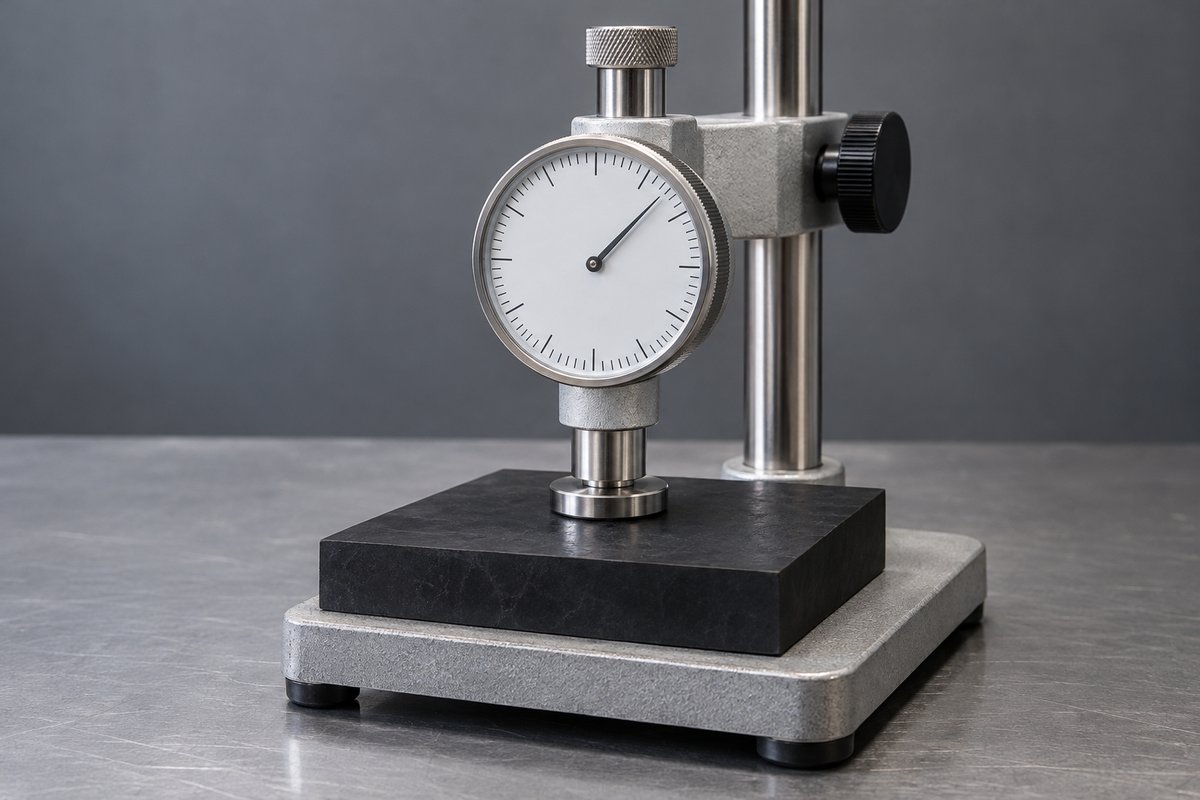
Durometer is the hardness of rubber measured as resistance to indentation, on a scale from 0 to 100. Most molded rubber parts are specified on the Shore A scale; very soft materials use Shore 00 and hard elastomers and plastics use Shore D. A higher number means a harder material.
Durometer scales
| Scale | Used for | Notes |
|---|---|---|
| Shore 00 | Very soft materials — gels, sponges, soft foams | Overlaps the bottom of Shore A |
| Shore A | Most rubber parts — seals, gaskets, O-rings, keypads | Typical molded rubber is about 30–90 Shore A |
| Shore D | Hard rubbers and plastics | Overlaps the top of Shore A |
Measurement standards: ASTM D2240, ISO 48-4 and JIS K 6253-3 (type A durometer corresponds to Shore A).
Typical hardness of rubber parts (guide)
| Shore A | Feel | Typical parts |
|---|---|---|
| 20–30 | Very soft | Soft-touch pads, very compliant seals |
| 40–50 | Soft | Keypads, low-force seals, gaskets on thin covers |
| 60–70 | Medium | General gaskets, O-rings (70 A is the most common O-ring hardness) |
| 80–90 | Hard | High-pressure seals, wear pads, rollers |
Values are approximate guides; the right hardness depends on the sealing force available, pressure and the mating parts.
How to specify hardness
- Write it as a value with tolerance, e.g. 70 ± 5 Shore A — ±5 is a common tolerance for molded rubber.
- Measure on a test piece or flat area of adequate thickness; thin or curved sections read differently.
- Hardness alone does not define a compound: two 70 A materials can behave very differently in compression set, temperature and fluids. Specify the polymer as well.
FAQ
What durometer is a typical rubber gasket?
Many general gaskets are 50–70 Shore A. Softer materials seal with less force; harder materials resist extrusion under pressure.
What is the difference between Shore A and Shore D?
They use different indenters and forces. Shore A is for soft and medium rubbers; Shore D is for hard rubbers and plastics. Readings on the two scales are not directly convertible.
Why is hardness tolerance ±5 Shore A?
Rubber compounds vary slightly batch to batch, and the measurement itself has scatter. ±5 Shore A is a common commercial tolerance; tighter tolerances can be discussed but may affect cost.